Argon Depletion in Insulated Windows
Understanding Your Home's Insulated Windows
If you have ever noticed condensation forming inside your multi-pane windows or wondered if the insulating gas trapped inside them eventually wears out, you are not alone. Modern energy-efficient windows rely on insulated glass units (IGUs)—a structure where two or more panes of glass are sealed around a perimeter spacer bar to create a trapped airspace. To significantly boost energy performance, window manufacturers fill this internal airspace with argon gas rather than standard room air.
Hearing that your windows are losing argon gas can sound like an immediate home maintenance emergency, but it is actually a slow, natural aging process. Understanding the critical difference between normal, gradual argon seepage and a total seal failure can save you thousands of dollars in unnecessary window replacements.
Key Takeaways
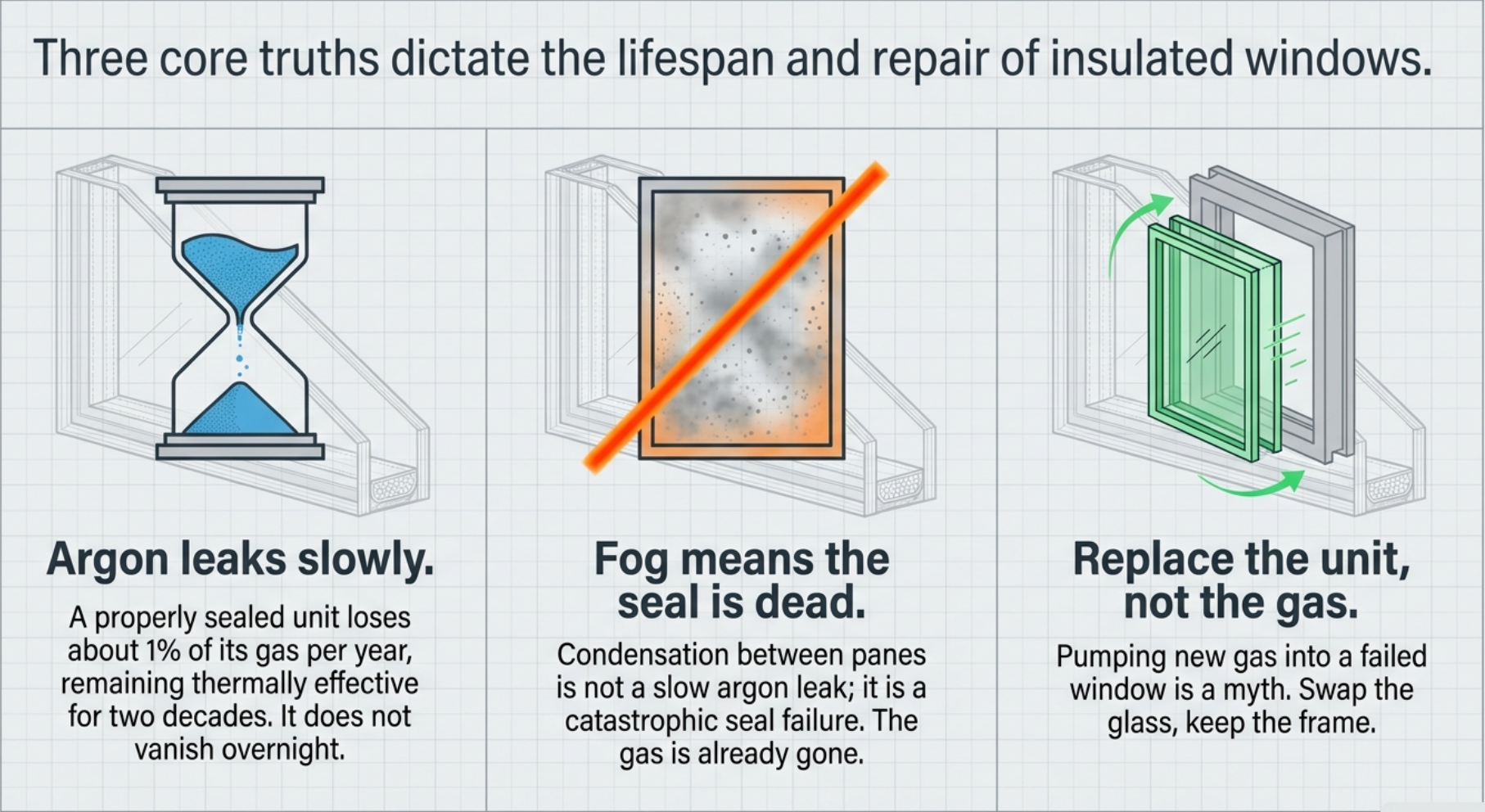
- Slow Natural Leakage: Argon gas escapes through normal micro-seepage at a rate of approximately 1% per year; a clear window remains effective for roughly 20 years.
- Fog Equals Broken Seal: Visible moisture or fog between the panes indicates a structural seal failure where all gas has escaped—it is not a natural gas depletion issue.
- Refills Are Ineffective: Injecting fresh argon gas into a window with a failed seal will not fix the issue; replacing the glass unit itself is the proper, cost-effective solution.
What Is Argon Gas and How Does It Work?
Argon is an odorless, tasteless, non-toxic, and completely inert gas that naturally makes up about 0.93% of the air we breathe. Because it is chemically inert, it poses zero health or environmental risks even if a window pane shatters.
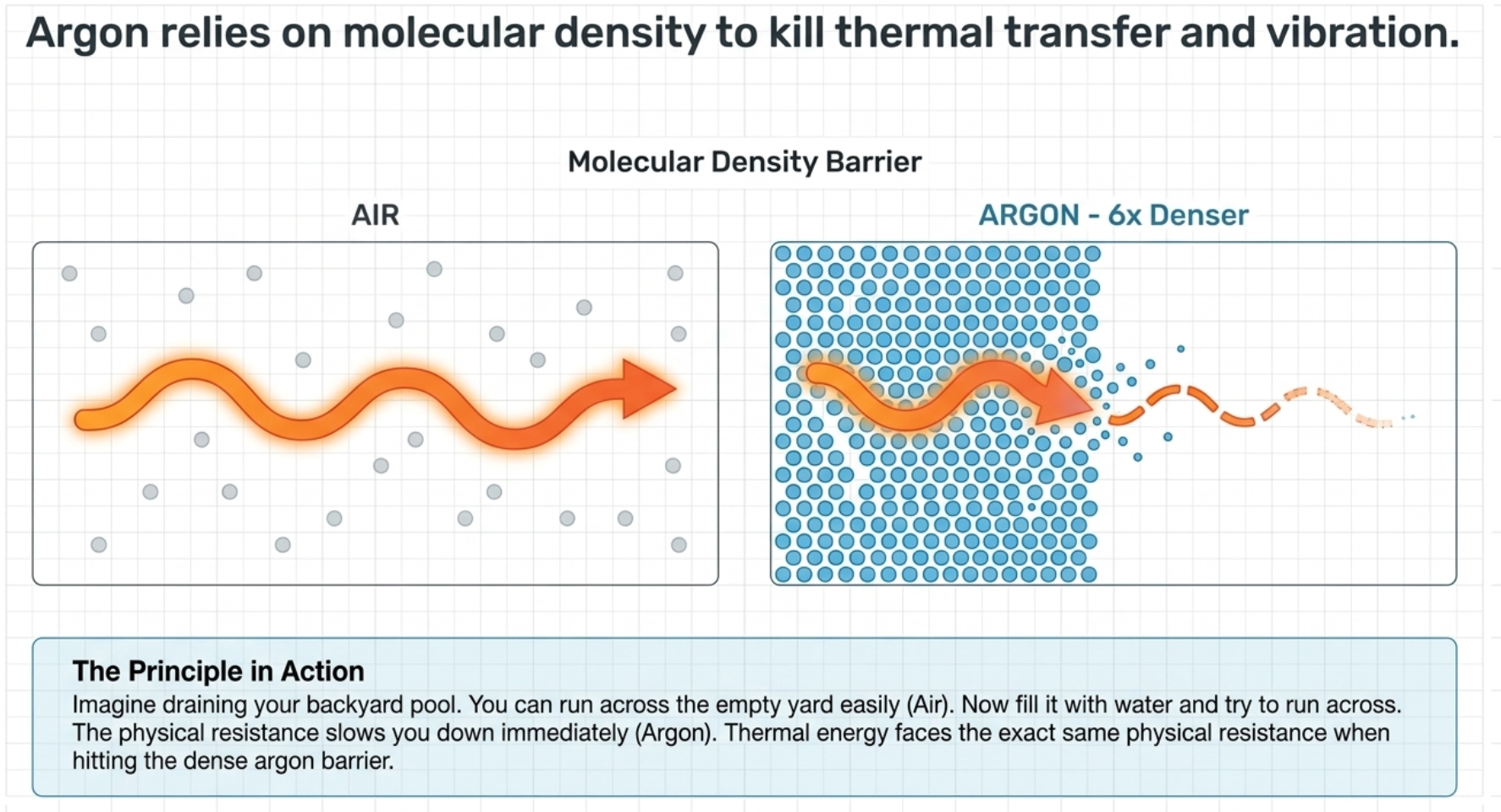
In residential windows, argon serves as a dense thermal barrier. Argon is six times denser than air and conducts approximately 33% less heat. By filling the cavity between glass panes with argon, heat and cold transfer through the window is drastically slowed down—much like trying to run through a pool filled with water instead of an empty pool. Additionally, its high density helps dampen sound vibrations, providing a quieter indoor environment.
Manufacturing Fill Methods
To assemble an IGU, glass manufacturers sandwich a spacer bar between two glass panes and fill the internal cavity with argon gas to a target fill level between 90% and 95%. Manufacturers primarily utilize two distinct methods to insert the gas:
- The "Poke" Method: In this traditional assembly process, workers pierce the edge seal with a specialized needle to inject argon while simultaneously vacuuming out room air through a second hole. This process is rarely 100% efficient because some argon is inevitably sucked back out during vacuuming. Crucially, piercing the edge seal leaves a physical hole that must be plugged, creating a permanent structural weak point in the unit.
- Argon-Enriched Chamber Assembly: In this superior, modern manufacturing method, the entire glass-and-spacer "sandwich" is assembled inside an enclosed, sealed chamber filled entirely with argon gas. This eliminates the need to puncture the edge seal, creating a leak-free unit without any artificial weak points.
The longevity of the argon fill depends heavily on the quality of the window’s edge seal—typically made of high-durability butyl (a synthetic rubber that never dries out) and silicone—and the window spacers (such as stainless steel or aluminum U-spacers). Spacer channels also contain desiccant beads designed to absorb any residual manufacturing moisture inside the cavity.
To verify seal integrity, window quality is governed by strict testing standards. European EN 1279-3 standards establish a maximum allowable leakage ceiling of 1.0% per year (with no single test unit exceeding 1.2% per year). Separate accelerated environmental testing simulates 30 years of extreme weatherization, hot/cold swings, and moisture exposure. In these rigorous 30-year simulation chambers, high-quality units (such as Cardinal IGUs) enter at roughly 95% gas fill and exit at approximately 92% fill—far surpassing the standard 70% passing threshold required for certified argon windows.
Argon Depletion vs. Complete Seal Failure: What’s Happening to Your Windows?
Homeowners often confuse normal gas depletion with total window failure. However, these are two entirely different events with distinct physical causes, thermal impacts, and solutions.
Gradual Argon Loss (Normal Aging)
Argon gas slowly diffuses out of an intact window via micro-seepage through the perimeter butyl edge seal at a standard rate of about 1% per year (the maximum ceiling allowed under EN 1279-3 standards). Because factories fill units to around 92% to 95% argon, it takes 12 to 15 years to cross below the 80% fill threshold—the baseline industry standard established by the National Glass Association for peak efficiency—and over 20 years to drop further.
Crucially, dropping from a 90% fill down to 80% reduces the unit's total insulating value by only 2% to 3%, costing an average home roughly $2 to $4 per year on utility bills.
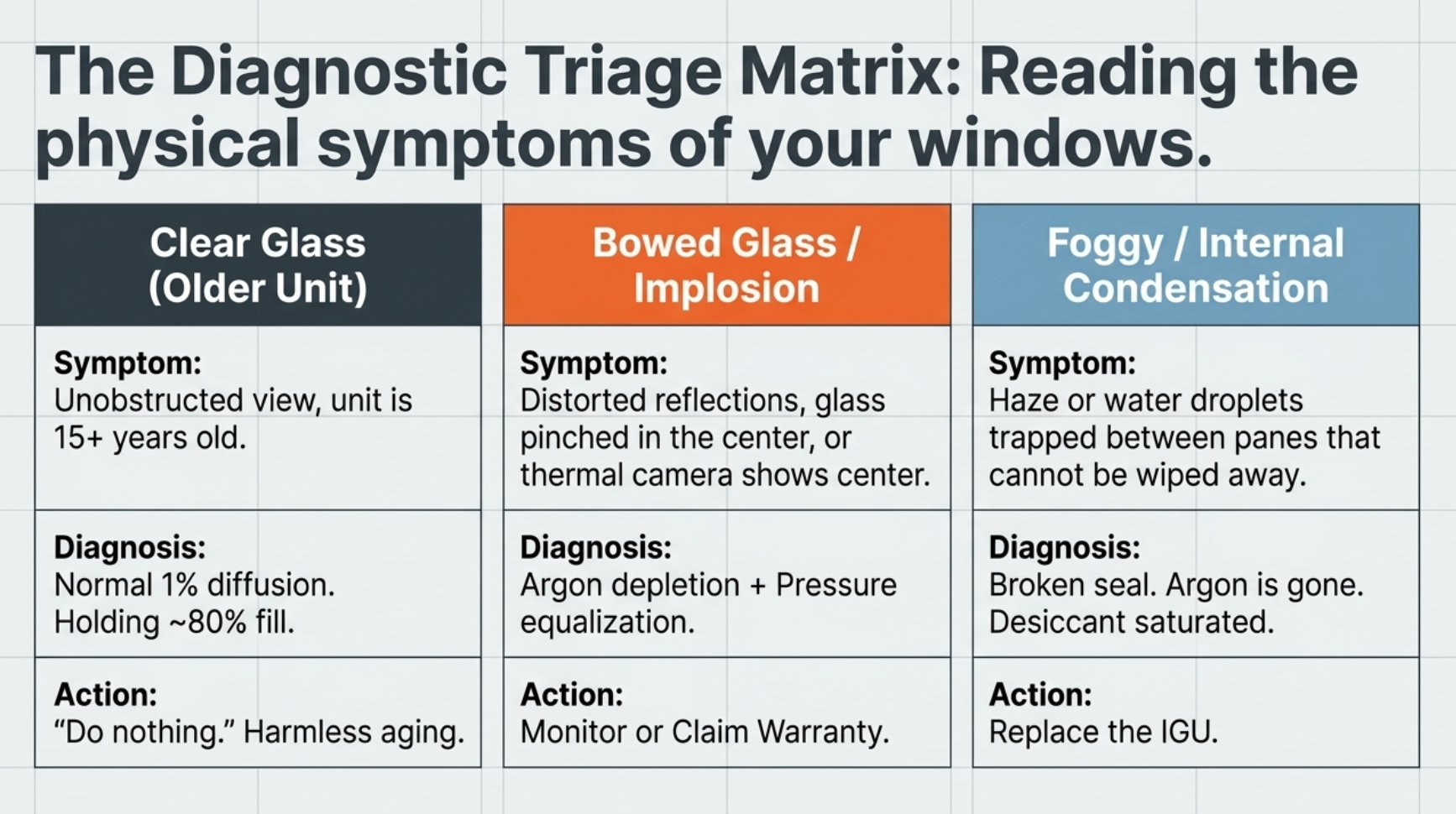
During energy audits or infrared camera inspections, gradual argon loss reveals a unique physical phenomenon. Because argon molecules are tiny, they escape through the butyl seal due to gas pressure equalization. However, larger atmospheric air molecules (such as nitrogen and oxygen) cannot pass inward through the intact edge seal to replace them. After 5 to 10 years, this gas loss creates an internal negative pressure vacuum visible under thermal imaging as a center-of-window thermal anomaly:
- On larger windows, the flexible glass panes bow inward toward each other.
- On smaller units with less flexible glass, the pressure imbalance can exert so much force that the panes actually implode or shatter.
Seal Failure & Fogging (Actual Damage)
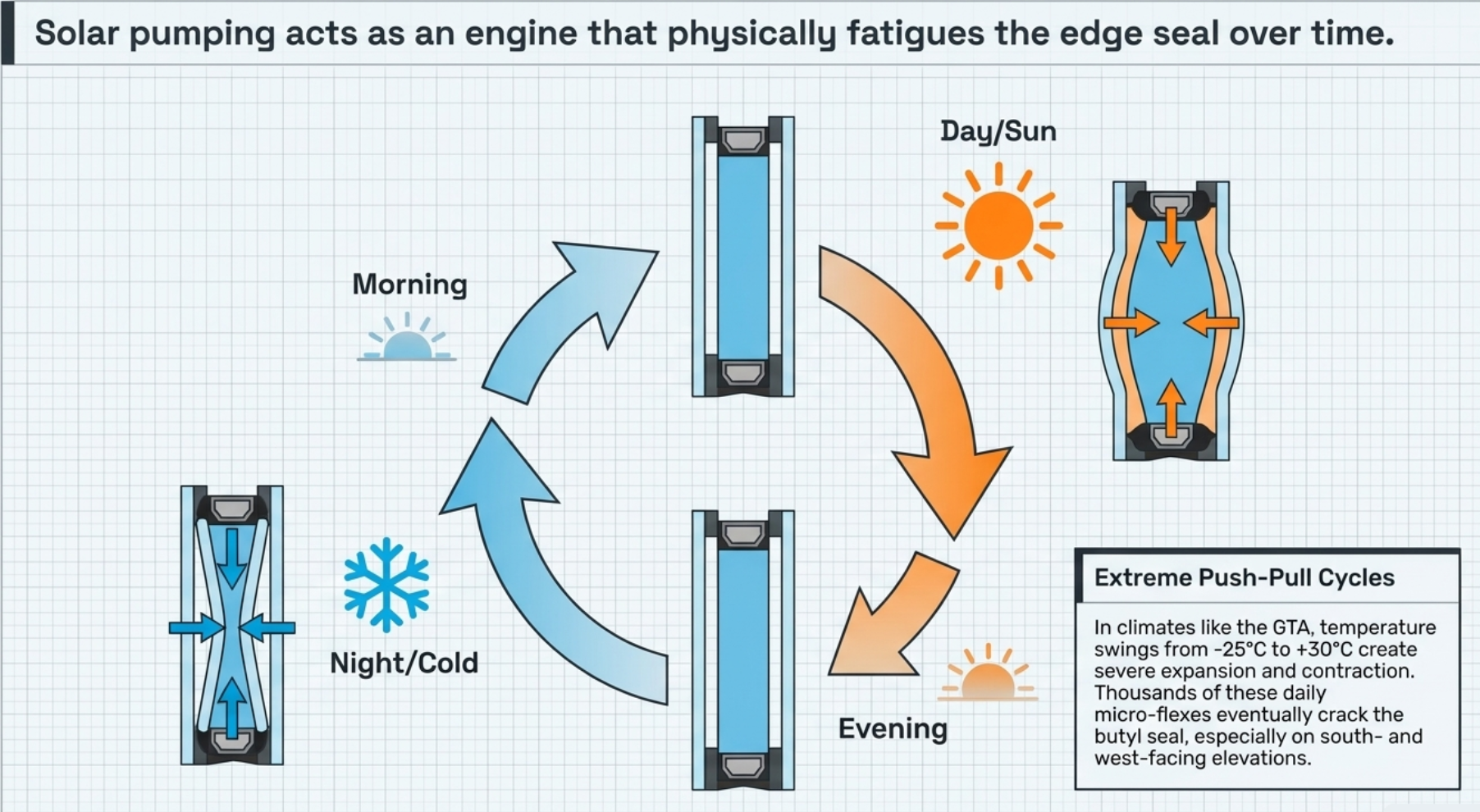
While argon depletion is an invisible, harmless aging process, seal failure is an outright mechanical breakdown of the window unit. The primary driver of seal failure is solar pumping—a relentless daily expansion and contraction cycle. Sunlight heats the gas trapped between the panes, causing it to expand and press outward against the edge seal. At night, the cavity cools and contracts, pulling the glass inward.
Over thousands of these expansion and contraction cycles—amplified by extreme regional climate variations (such as Canadian winter drops to -25°C and summer spikes reaching +30°C)—the butyl seal eventually fatigues and cracks. When the seal pops, it can sometimes produce an audible sound almost like a gunshot.
Once the perimeter seal is breached, the trapped argon exits immediately. The resulting internal thermal circulation creates a vacuum that sucks moist outdoor air into the cavity. Once the internal desiccant beads become saturated, condensation forms dead-center on the inside surfaces of the glass, creating permanent fog, haze, or mineral streaking.
Common Myths & Misconceptions Debunked
Myth 1: "You can simply refill the argon gas in a foggy window."
The Reality: Refilling a window that has fogged up is completely ineffective. If a unit has lost enough gas to fog, the perimeter seal is physically broken. Injecting new gas into a compromised unit will fail because the argon will immediately leak back out, and the saturated internal desiccant can no longer absorb moisture.
Refilling argon into a failed seal is like topping up a tire with the nail still in it. The air is not the problem. The hole is.
Myth 2: "Krypton gas is a vastly superior replacement for standard double-pane windows."
The Reality: Krypton gas is 7 to 8 times denser than air (weighing roughly 3.75 kg/m³) and insulates approximately 40% better than argon in narrow gaps. However, krypton costs 2 to 3 times more than argon and leaks through edge seals at the exact same rate (~1% per year). Furthermore, krypton is engineered specifically for narrow 6mm to 10mm cavities in triple-pane windows; in standard 12mm to 16mm double-pane gaps, it offers virtually no extra thermal benefit over standard argon.
Myth 3: "Clear 15-year-old windows must be replaced immediately because the argon ran out."
The Reality: Even after 15 to 20 years, a clear window that started at a 92% fill level still retains around 75% to 80% of its original argon gas. The total drop in insulation performance over two decades is only about 4% to 5%. Even if an old window completely lost its argon, it would still perform identically to an ordinary air-filled double-pane window. If the glass remains crystal clear, there is no technical or financial justification for replacing it.
Conclusion & Next Steps
Understanding window physics prevents unnecessary household expenses. The slow leakage of argon gas (~1% per year) is a harmless physical reality that takes decades to impact your comfort or energy bills. Clear windows—regardless of age—should simply be left alone. If you see fog, condensation, or liquid between the glass, your edge seal has failed, but you can typically fix the problem by replacing the glass unit alone rather than paying for a full-frame replacement.
Homeowner Action Checklist:
- [ ] Inspect Clear Windows: Leave all clear, un-fogged windows alone, regardless of their age.
- [ ] Identify Fogged Units: Check south- and west-facing windows (which take the most direct sun and thermal stress) for central condensation or permanent internal haze.
- [ ] Check Warranty Records: Look up original sales receipts, spec sheets, and spacer stamps to see if failed seals are covered under a manufacturer's lifetime or multi-year warranty.
- [ ] Assess Window Frames: Inspect window frames for rot, water damage, or structural racking; if frames are sound, request quotes specifically for an IGU glass pack replacement.
- [ ] Schedule Rebate Assessments: If replacing entire windows, book a certified pre-retrofit energy assessment before ordering or installing units to qualify for active regional rebates.
- [ ] Collect Multiple Bids: Always secure at least three detailed bids from reputable, certified window contractors before committing to major window replacements.

.png)